
How WPWT tanks are built
Five engineered details. Built for booster, boiler, expansion and irrigation systems.
Five details on every tank
Standard on all four sizes, in FDA compliant materials. No upgrades to explain on the counter.
Double O-ring air valve
Leak-free cap design holds the factory pre-charge. No slow air leaks, no frequent top-ups.
High-pressure diaphragm
Antibacterial butyl membrane, built to separate air and water under high pressure, cycle after cycle.
Tested powder coating
Finish tested for adhesion strength. Resists chipping and rust on site.
Stainless connector
1 inch BSPT system connection in stainless steel. Resists corrosion at the joint.
Thick carbon steel shell
Extra-thick wall for strength and service life. The foundation of the WPWT range.
Certificates on request
Documents for tenders and project submissions. Ask on WhatsApp.
NSF
National Sanitation Foundation certification.
CE
European conformity marking.
RoHS
Restricted substances compliance.
ISO
Quality management system certification.
FDA
Food grade materials compliance.

How the tank holds pressure
Air behind a butyl diaphragm stores water under pressure. The pump starts less often and lasts longer.
Pump fills the tank
Water enters and compresses the air cushion behind the diaphragm.
Pressure is stored
Air pressure holds water ready for instant use.
Tap opens, water flows
Stored water feeds showers, taps and irrigation lines at steady pressure.
Pump cycles less
When pressure falls to cut-in, the pump restarts. Fewer starts mean longer pump life.
Fixed diaphragm, in plain terms
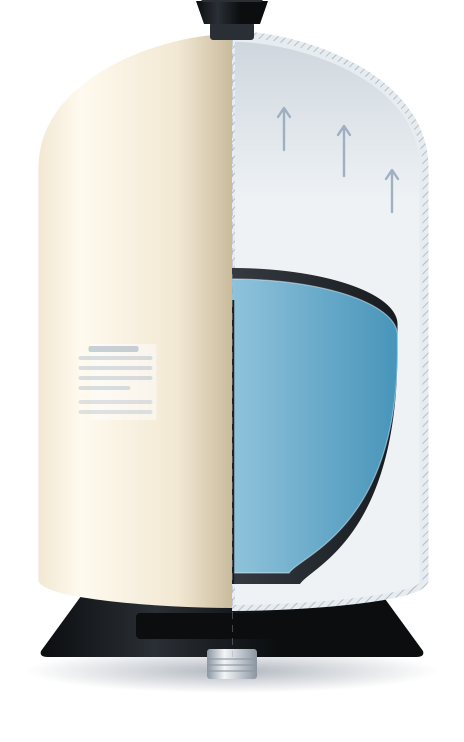
A fixed diaphragm pressure tank is a steel shell divided by a single butyl sheet into two chambers. The sealed upper chamber holds air, charged at the factory to 1.9 bar (28 psi). The lower chamber takes water from the pump. Air compresses and water does not, so the tank stores water under pressure and releases it the moment a tap opens, letting the pump run in longer, calmer stretches instead of switching on at every draw.
Fixed means the diaphragm is clamped to the shell rather than pushed in as a replaceable bladder: there is no bladder to fold, chafe or tear, and the air charge is set through a double O-ring valve and can be topped up between 1.5 and 2.5 bar (22.5 to 37.5 psi) at service.
The shell is thick carbon steel, powder coated and tested at 14.3 bar (215 psi) against a 10 bar (150 psi) working limit. The diaphragm is rated to 90 °C and the connector is stainless steel with a 1 inch BSPT thread. All four volumes, 24, 35, 60 and 100 litres, are built to that one specification, so a dealer stocks one design in four sizes. Sizing follows the pump and the outlets it feeds; the applications guide sets out where each volume fits.
Full technical file
Dimensions, volumes and pressure figures in the catalog PDF. Submittal data on request.